Ukraine and Sweden Discussed Countering Cyber and Hybrid Threats
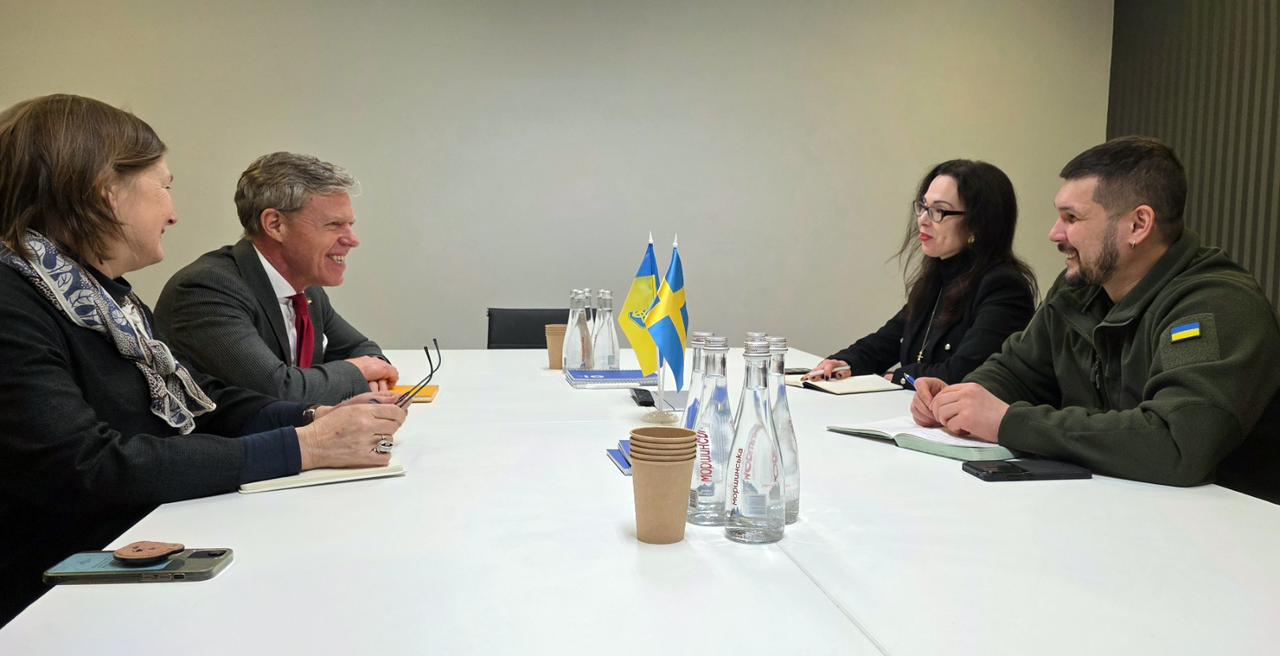 A working meeting between Ukrainian and Swedish delegations took place at the National Cybersecurity Coordination Center at the National Security and Defense Council of Ukraine. The Ukrainian side was represented by Valerii Churkin, Coordinator for Digitalization, Artificial Intelligence, and Cybersecurity at the Office of the NSDC of Ukraine, and Natalia Tkachuk, Head of the Department of Information Security and Cyber Protection at the Office of the NSDC of Ukraine and Secretary of the NCSCC.
The Swedish delegation included Jakob Ström, Deputy Director within the Department for Security Policy and Foreign Policy Coordinator for Preparedness and Response to Hybrid Threats at the Swedish Ministry of Foreign Affairs; Filippa Arvas Olsson, Senior Advisor within the Department for Cyber and Hybrid Affairs at the Swedish Ministry of Defense; and Fanny Wessner, Second Secretary at the Embassy of Sweden in Ukraine.
During the meeting, the parties discussed the current cyber and hybrid threats facing Ukraine in the context of the full-scale armed aggression by the Russian Federation, in particular the complex combination of cyberattacks, information and psychological operations, and kinetic strikes on critical infrastructure. Particular attention was paid to the coordination of cybersecurity entities, the role of the NCSCC in shaping and implementing state policy in this area, as well as Ukraine’s practical experience in countering large-scale cyber campaigns by the enemy.
Valerii Churkin, Coordinator for Digitalization, AI, and Cybersecurity at the National Security and Defense Council of Ukraine, emphasized that effective countering of modern threats requires a combination of state institutional mechanisms, private sector capabilities, and civil society.
“Russia systematically combines cyberattacks, disinformation, and military action into a single instrument of pressure. Our key task is to ensure coordination and speed of response, as well as to institutionalize the volunteer and technological capabilities that proved effective in the early days of the full-scale war,” he said.
Natalia Tkachuk, Secretary of the NCSCC at the NSDC of Ukraine, informed the Swedish partners about the role of the NCSCC as a coordinating body in the state cybersecurity system and about the experience of the interagency mechanism under crisis conditions.
“The National Cybersecurity Coordination Center provides practical coordination of the actions of all key actors in the field of cybersecurity. Thanks to such interaction, Ukraine has managed to maintain stability in cyberspace during the most critical periods and quickly adapt to new threat models,” she emphasized.
In turn, Jakob Ström, a representative of the Swedish Ministry of Foreign Affairs, noted Ukraine’s unique experience in countering hybrid threats and expressed interest in further studying it.
“Ukraine is currently at the forefront of the fight against hybrid and cyber threats. It is extremely valuable for us to understand how coordination between state bodies, security structures, and society is organized, and what practical lessons from this experience can be applied to increase the resilience of our institutions,” he said.
Following the meeting, the parties agreed to deepen expert dialogue, develop working contacts between relevant agencies in Ukraine and Sweden, and explore possible formats for further cooperation in the field of cyber and information security, particularly in terms of sharing analytics and best practices for countering hybrid threats.